













Have you ever wondered why March 17 is always associated with green? Have you ever heard of St. Patrick? Have you ever wondered why the saying is always to wear green, or else you’ll get pinched? All of these questions point us to St. Patrick’s Day.
The origin of St. Patrick’s Day dates to approximately 1,000 years ago and honors Ireland’s patron saint, St. Patrick. This holiday is always celebrated on March 17th because it is the day St. Patrick died. The Irish have observed this day as a religious holiday for over 1,000 years. Although this day falls during the Christian season of Lent, most Lenten observances were waived so that people could dance and drink on this day of celebration. The traditional meal most people ate during this period was Irish Bacon and Cabbage.
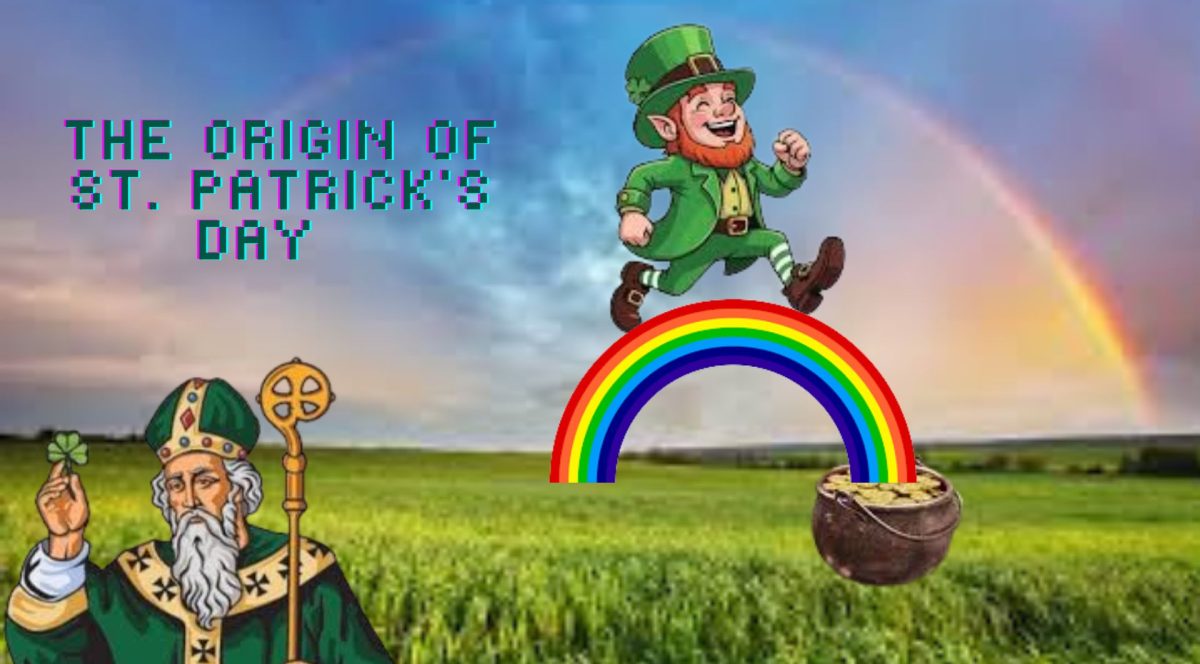
St. Patrick lived during the fifth century and is the current saint of Ireland. He was born in Roman Britain. When he was 16, he was kidnapped and brought to Ireland as a slave. He later escaped but returned to Ireland to bring Christianity to the people there. In the time that followed St. Patrick’s, the mythology surrounding his life had become increasingly ingrained in Irish culture. One of St. Patrick’s best-known stories was his use of a shamrock to explain the Holy Trinity. There are three parts to the Holy Trinity, and they are the Father, the Son, And The Holy Spirit. A shamrock is a plant with three leaves on a single stem. St. Patrick then used this to his advantage, crafting an explanation that made sense to others. St. Patrick taught others Christianity until his death on March 17, 461 AD. Though the year of his death has been debated by many, they all agree that he died on March 17. This date became his Feast Day, marking the holiday’s early origins.
People in Ireland have observed a Roman Catholic feast day honoring St. Patrick on March 17 since around the 9th or 10th century. Surprisingly, the first St. Patrick’s Day parade didn’t take place in Ireland but in America. From records that we currently have, the first St. Patrick’s Day parade occurred on March 17, 1601, in the Spanish colony of St. Augustine, Florida. From this point on, there were celebrations of the holiday in some form each year. The holiday’s popularity would only grow from here, given the rapid expansion in how people choose to celebrate it.
Since the 1950s, St. Patrick’s Day has always been symbolized by a leprechaun. This seems odd because leprechauns have nothing to do with the holiday itself. To better understand this question, we first need to determine what a leprechaun is. A leprechaun is a solitary, diminutive fairy-folk in Irish mythology. These creatures are often depicted as old, short, bearded men wearing green coats. They are often depicted as mischievous creatures driven by greed. They are believed to work as shoemakers. They are most commonly known for guarding pots of gold and for being tricky, fast-moving creatures that can grant three wishes if they are captured. If they are captured, they usually try to trick their captor into looking away so they can escape. Their popularity surged in America in the 1950s and 1960s. They were primarily regarded as symbols of cultural pride and folklore within the Irish-American community. The key media that helped create and solidify the images we know today were the 1959 Disney movie Darby O’Gill and the debut of Lucky the Leprechaun for Lucky Charms in 1964. A less commonly known fact about leprechauns is that they were originally described as ugly, mean, and wearing red rather than the now-recognized green.
St. Patrick’s Day is a wonderful holiday to celebrate with family and friends. It’s also important to understand the origin and meaning of the holiday to truly enjoy the festivities. St. Patrick’s Day is especially important to the students and staff of St. Vincent- St. Mary High School because our mascot is a leprechaun. We are known as the Irish, and each day we demonstrate our Marist and Irish roots through our actions inside and outside of school. We view every day as an opportunity to help others and to represent our school in a positive way.