








When you think of the Wild West, what is the first thing that comes to mind? If you are like me, thoughts of gunslinging cowboys, justice-serving sheriffs, bandits wearing bandanas, and a band of vigilantes come to mind. You wouldn’t be totally wrong, but the Hollywood film industry has made the Wild West into something it isn’t.
If you want to learn more, slap some bacon on a biscuit and let’s go! We are burnin’ daylight!
Overview
The Wild West era took place from 1850 to 1900. According to Terry Anderson, Professor Emeritus of Economics at Montana State University, the Wild West encompassed a vast area stretching from the Rocky Mountain states, such as Montana, all the way down to Texas, and then across the West Coast. The vast
expanse of terrain was largely unincorporated at the time.
The lack of a government is partly to blame for the collective portrayal of the time. It is depicted as a rowdy and fierce place to live, where you are always in a state of anarchy. When in reality, people understood the repercussions of fighting and found civil ways to resolve their issues.
For example, cattle owners, or herders, would divvy up vast plots of land and form associations in order to document range rights. There was even a market for property rights, and it worked well.
In 1851, Congress passed the Indian Appropriations Act, which established the first reservations where American Indians were forcefully relocated and prohibited from leaving without explicit permission. Meanwhile, the Wild West wasn’t some sort of small government utopia for the white settlers, as stated in Live Science.
Mathieu Couttenier, a political economist at the University of Lyon in France, delved into the crime statistics of the frontier in the 1800s in a 2017 study in the Journal of the European Economic Associations. Counttenier found that parts of the Wild West were more violent than the Eastern states, mainly where gold and other minerals were plentiful. Murder and physical assault were also common. He stated, “We’re talking about a 3% to 4% increase in crime in counties with minerals and no federal control compared to those with no minerals and which were incorporated into the United States.”
The Infamous Gunfight at the O.K. Corral
The most infamous gunfight of the Wild West era was the Gunfight at the O.K. Corral on October 16, 1881, in Tombstone, Arizona. There were two sides to this conflict. One side was a gang known as the ‘Cowboys,’ and the other consisted of the Earp brothers and their friend Doc Holliday. The ordeal only lasted 30 seconds, but by the end of it, three outlaws were murdered. According to History Extra, the Earp brothers and Holiday were arrested on charges of murdering brothers Tom and Frank McLaury and 19-year-old Billy Clanton. They stood trial and were put behind bars before ultimately being released.
The gunfight didn’t become widely known until 1931, when Stuart N. Lake published a biography of Earp. The biography inspired the classic films My Darling Clementine and Gunfight at the O.K. Corral. In reality, shootouts didn’t happen the way they are portrayed in movies. The shooters are very close together, usually around six feet. The Gunfight at O.K. Corral was also portrayed incorrectly in most western movies. The fight was not preplanned, and all of the shots that were fired came from handguns. Also, the location was not at the O.K. Corral but rather at a vacant lot on the side of a photography studio. The Cowboys that died are reduced to your everyday villains when shown in movies.
The names of Holiday and the Earp brothers joined the long line of some of the most famous names to come out of the wild west, such as Billy the Kid, Butch Cassidy, and The Sundance Kid.
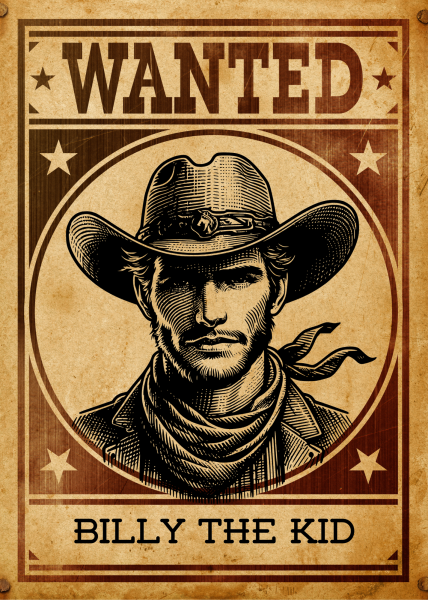 Billy the Kid
Billy the Kid’s real name is William H. Bonney, but he also went by the name Henry McCarty. He had a short career as an outlaw, and by the time of his death, he had confessed to eight murders.
It began when Kid murdered a blacksmith who was bullying him. From there, he took part in a violent fight known as the Lincoln County War in New Mexico. He sided with a gang called The Regulators.
Billy the Kid was convicted of killing William J. Brady, the Lincoln County sheriff, during the altercation. He wasn’t caught and remained at large until he killed Joe Grant in a daloon in Fort Summer, NM. Kid was captured by Sheriff Pat Garrett in December of 1880 and was sentenced to death. He escaped by killing his guards and remained on the run for two months until Garrett found him again in Fort Summer.
Billy the Kid died on July 14, 1881, at the age of 21, in a shootout with the sheriff, who later wrote a book called The Authentic Life of Billy the Kid.
Butch Cassidy
Robert LeRoy Parker, who went by Butch Cassidy, was born in 1866 in Utah. He began his crime streak by stealing a pair of jeans. In 1896, Cassidy formed a gang, The Wild Bunch, with a group of friends. He later recruited Harry Alonzo Longabaugh, also known as The
Sundance Kid. The group pulled off many successful train robberies and caught the attention of the Pinkerton Agency.
In 1901, Butch Cassidy and the Sundance Kid fled to South America. In November of 1908, the pair robbed a courier carrying the payroll for a silver mine. It is believed that both were killed in a shootout with police following the robbery.
Butch claimed to have never killed anyone.
The Sundance Kid
The Sundance Kid worked as a ranch hand until he started his life of crime by stealing a horse. He adopted the name Sundance after the town where he was jailed for the crime.
He joined Butch Cassidy’s Wild Bunch in 1896. At that point, his career took off with train robberies. He was forced to South America in 1901 with his long-term partner, Butch Cassidy.
They were both killed in a shootout with police after a robbery gone wrong.
Railroads and Pioneers
According to History Extra, ever since pioneers began exploring inland from the English settlement at Jamestown in Virginia, the rolling western frontier was a more dangerous place than it was toward the end of the 19th century, when many Westerns are set. Some of the circumstances that made the West dangerous include the unforgiving natural terrain, the fact that most newcomers were single males who bought firearms with goldrush cash, and those in wagon trains were susceptible to severe weather, Native American raids, and

bandit attacks.
Four years after the Civil War, the Central Pacific and Union Pacific railroads were connected to form the first Transcontinental Railroad. During the construction of the railroad, companies eradicated wild bison numbers on the plains. The bison provided meat for the workers, and as their numbers declined, the risk to trains decreased.
Some historians believe that the completion of the railroad marked the end of the Wild West.
Below is a poem by Aurther Chapman about the Wild West:
Out Where the West Begins
Out where the handclasp’s a little stronger,
Out where the smile dwells a little longer,
That’s where the West begins.
Out where the sun is a little brighter,
Where the snows that fall are a trifle whiter,
Where the bonds of home are a wee bit tighter,
That’s where the West begins.
Out where the sky’s are a trifle bluer,
Out where the friendship’s a little truer
That is where the West begins.
Out where a fresher breeze is blowing,
Where there’s laughter in every streamlet flowing,
Where there’s more of reaping and less of sowing,
That’s where the West begins.
Out where the world is in the making,
Where fewer hearts with despair are aching,
That’s where the West begins.
Where there’s more of singing and less of sighing,
Where there’s more of giving and less of buying,
And a man makes friends without half trying,
That’s where the West begins.
— Arthur Chapman