









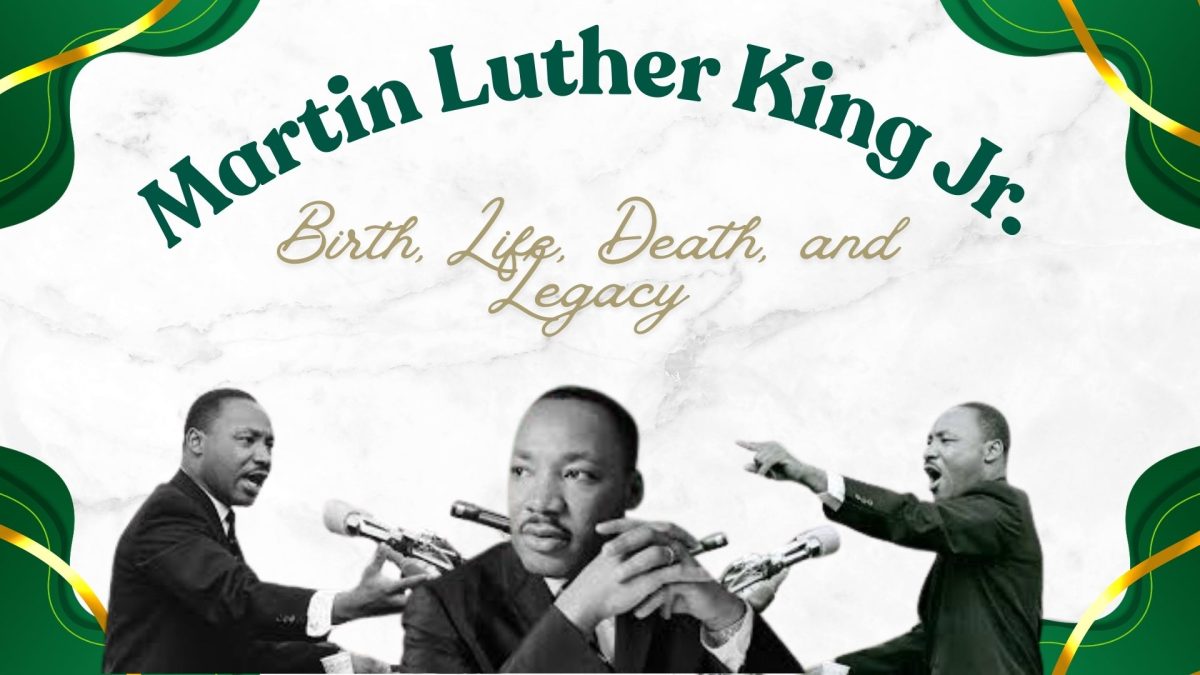
Have you ever wondered why the third Monday of January is always a holiday?
Have you ever heard of Martin Luther King Jr.?
If you haven’t, Martin Luther King Jr. is one of the most important people involved in the Civil Rights Movement. The civil rights movement fought against discrimination against African Americans. The Civil Rights Movement led to the Civil Rights Act of 1964, which made it illegal to discriminate against individuals based on race, color, religion, sex, or national origin. This ended segregation in public places, schools, and workplaces. It also prohibited unequal voter registration.
None of this would have happened if not for Martin Luther King Jr.’s help.
Before we can understand this great achievement, we need to go back to the beginning of his life. Martin Luther King Jr. was born on January 15, 1929, in Atlanta, Georgia. His parents were Martin Luther King Sr. and Alberta Williams King. He had a younger brother and an older sister, and their names were Alfred Daniel King and Christine King Farris. At Birth, Martin’s original name was Michael King Jr. This name followed his father, Michael King Sr. In August of 1934, Michael King Sr. decided to change his name to Martin Luther King Sr. He also changed his son’s name from Michael King Jr to Martin Luther King Jr. King’s father was a Reverent at his local church, which guided a lot of his beliefs and actions towards equality for all. He was also able to see firsthand how to deal with racism and discrimination from his father. His father had to deal with a lot of discrimination and racism, and he fought back with a confident but respectful tone. This guidance and image greatly helped King on how to deal with these topics on his own.
When he was an adult, he had already started to become an activist and protest against discrimination. The Montgomery bus boycott was the first major event that was able to give King the big push he needed. He also gained a lot of attention due to being arrested for driving 30 mph in a 25 mph zone. The boycott ended when the US District Court issued a ruling in the Browder v. Gayle case that prohibited racial segregation on Montgomery’s public buses. This was a great step for King and the Civil Rights Movement. After this, he rose to a National figure and was the best-known spokesperson of the Civil Rights Movement.
All of the rising fame led him to the thing for which he is most known, which was the March on Washington. The March on Washington took place on August 28, 1963, in Washington, D.C. During this event, King delivered one of his most famous speeches, known as the “I Have a Dream” speech. This event was massive for the Civil Rights Movement and united all African Americans in demanding change. They finally got the change they wanted the following year in 1964 with the Civil Rights Act of 1964. The Civil Rights Act of 1964 banned the act of discrimination against individuals based on race, color, religion, sex, or national origin. It also ended segregation in public spaces, schools, and workplaces. Last but not least, it also prohibited unequal voter registration.
After the passage of the Civil Rights Act of 1964, Martin Luther King Jr. remained a very important figure in politics. He still fought for equality even after the Civil Rights Act was passed, due to the hatred and discrimination still very present towards African Americans. He still spoke to large crowds and was an energetic and influential figure in politics. He was definitely looked at by many for guidance and for courage on what to do next. He and many other civil rights leaders remained deeply involved with the community even after the rights were passed. They supported certain movements and groups, which helped both gain widespread public support and interest. King opposed America’s involvement in the Vietnam War; however, he tried to avoid the topic in speeches to avoid interference with the Civil Rights goal. After the rights were passed, he was able to speak more publicly and freely about the topic.
King always focused on the people who were always looked over and ignored. In 1968, he and the SCLC organized the “Poor People’s Campaign” to address economic Justice. He traveled the country to assemble “a multiracial army of the poor” that would March on Washington to engage in nonviolent civil disobedience at the Capitol until Congress created an “economic bill of rights.” This campaign was controversial within the Civil Rights Movement, which caused a lot of division within the group. On March 29, 1968, King went to Memphis, Tennessee, to support black sanitation workers represented by the American Federation of State, County, and Municipal Employees. The workers had been on strike since March 12th for higher wages and better treatment.
On April 3rd, King addressed a rally and delivered his “I’ve been to the Mountaintop” address.
On Thursday, April 4th, 1968, tragedy struck. King, at the time, was staying in Room 306 at the Lorraine Motel in Memphis. His last words were said to the musician, Ben Branch, who was scheduled to perform that night at an event that King was attending. His last words were, “Ben, make sure you play ‘Take My Hand, Precious Lord’ in the meeting tonight. Play it real pretty.” After this, at 6:01 P.M, King was fatally shot in the lower right side of his face and neck by James Earl Ray. King had been shot while he stood on the motel’s second-story balcony. King was rushed to St. Joseph’s Hospital, where he underwent emergency surgery. Unfortunately, King’s wounds were too severe, and he died at 7:05 P.M at the age of 39. His death led to race riots throughout the country.
The SCLC received an unprecedented amount of donations after King’s assassination due to his support in the group. King’s funeral was on April 9, 1968, in Atlanta, Georgia. He first had a private service at his local church, which was then preceded by a public ceremony and procession at Morehouse College, which was his alma mater. He was then buried at South View Cemetery, before he was moved to the King Center. Over 100,000 mourners followed his casket, which was moving from the church through the streets of Atlanta to the college.
Although King died, his legacy was never forgotten, and his life and mission helped to create a world of equality for all. King is still looked up to by many today, and so we continue to celebrate his voice and life every January. His physical life may have abruptly come to an end; however, what he stood for and his legacy will never die.


Eva • Feb 28, 2026 at 9:54 pm
This is a good article! Proud of you Grayson!!